

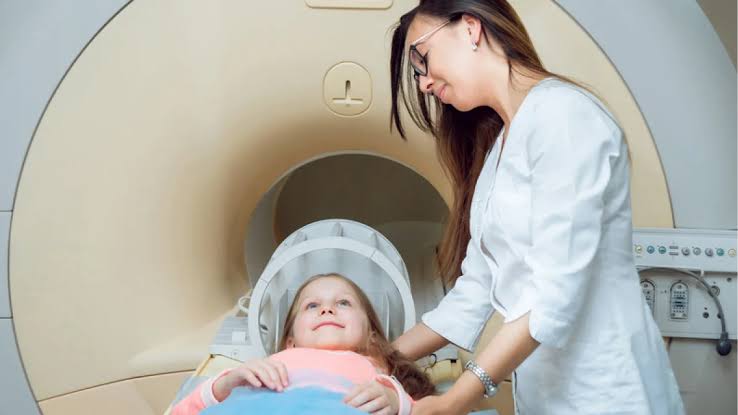
When a child is referred for an MRI, one of the first concerns parents raise is whether their child will need sedation. It is an understandable worry. MRI machines are loud, the enclosed environment of a conventional scanner can be frightening for anyone, and for young children who have no frame of reference for the experience, lying completely still for 20 to 45 minutes in a narrow tube can feel impossible.
The reassuring reality is that sedation is not always necessary, and for many children it can be avoided entirely with the right preparation, the right facility, and in some cases the right type of scanner. What parents need to know is how to give their child the best chance of completing a scan comfortably and safely without sedation when that is a realistic option.
Why Children Struggle With Conventional MRI
The design of a standard closed-bore MRI presents particular challenges for children. The narrow tunnel, typically 60 to 70 centimetres in diameter, requires the child to lie still inside a space that surrounds them on all sides. Even adults who are not particularly anxious can find this environment uncomfortable. For children, the combination of enclosed space, unfamiliar machinery, and the loud rhythmic noise of the scan sequence creates a genuinely distressing experience, particularly for children who have not had the opportunity to understand or mentally prepare for what to expect.
The requirement for stillness compounds the challenge. Even a small amount of movement during an MRI sequence can degrade image quality sufficiently to require the sequence to be repeated, extending the total time inside the scanner and increasing the likelihood that the child becomes more distressed rather than less.
At What Age Can Children Complete an MRI Without Sedation?
There is no universal age threshold for MRI without sedation. It depends on the individual child’s temperament, cognitive development, and how well they have been prepared. As a general guide, children under the age of six or seven typically require sedation for a conventional closed-bore MRI because they lack the capacity to understand the abstract instruction to hold still for an extended period and to maintain it under stress. Children between roughly seven and ten years old are more variable, with some completing conventional scans without sedation and others struggling significantly. Adolescents can generally manage conventional MRI without sedation when well-prepared, in the same way an adult would.
The Role of Preparation in Avoiding Sedation
Preparation is the single most effective tool for helping a child complete an MRI without sedation. Children who have a clear, age-appropriate understanding of what is going to happen, have had the experience described to them in non-threatening terms, and have been given a sense of control through practice and rehearsal manage the experience significantly better than those who arrive uninformed. Many paediatric imaging centres offer preparatory resources including video explanations, practice sessions with a mock MRI, or the opportunity to bring a favourite toy or comfort object into the room. Child-friendly MRI in Deerfield provides a significantly less intimidating environment than a conventional closed-bore scanner to begin with, which reduces the level of preparation required and makes the experience more manageable for a broader age range of children.
Explaining the noise of the scan in advance is particularly valuable. The loud, rhythmic banging that characterises an MRI sequence is startling if unexpected and can trigger panic in a child who was coping adequately until that point. Describing it as similar to a loud drumming sound, and letting the child hear a recording or demonstration beforehand, removes the surprise element that often destabilises an otherwise manageable experience.
When Sedation Is the Right Choice
For some children and some scan types, sedation is the appropriate and safest option, and parents should not feel that choosing sedation represents a failure to adequately prepare their child. Very young children, children with significant developmental delays or sensory processing differences, and children undergoing longer or more complex scan protocols may be best served by sedation, which ensures they remain still throughout, produces the highest quality images, and spares them an experience that could be traumatic.
Sedation for MRI in children is generally performed with short-acting agents that allow for rapid recovery, and the child is monitored throughout by qualified anaesthesia staff. The decision should be made in consultation with the referring physician and the imaging facility, weighing the child’s individual circumstances against the clinical requirements of the scan.
How Open and Upright MRI Changes the Equation
Open and upright MRI systems present a fundamentally different environment from conventional closed-bore scanners. Rather than entering a narrow tube, the child is positioned within a machine that is open on multiple sides, allowing them to see the room around them throughout the scan. The absence of the enclosed bore removes the primary source of claustrophobic distress and makes the experience feel significantly less threatening.
For children who would struggle with a conventional scanner but can manage a less confining environment, open MRI represents a meaningful expansion of who can realistically complete a scan without sedation. The technology is not appropriate for all scan types, and image quality considerations mean it is best suited to musculoskeletal imaging, spinal imaging, and certain head and neck applications rather than high-field neurological protocols. For the scan types where it is clinically appropriate, however, it can make the difference between a child who completes a necessary scan comfortably and one who requires sedation or is unable to complete the scan at all.
Conclusion
Whether a child needs sedation for an MRI depends on their age, temperament, the nature of the scan, and how well they have been prepared. Sedation is sometimes the right choice, but it is not the only option, and for many children, thoughtful preparation combined with the right imaging environment makes a sedation-free scan entirely achievable.
If your child has been referred for an MRI and you are looking for an approach that minimises distress and reduces the likelihood of sedation being necessary, learning more about a more comfortable MRI experience for children in an open upright environment is a worthwhile first step before finalising your appointment.