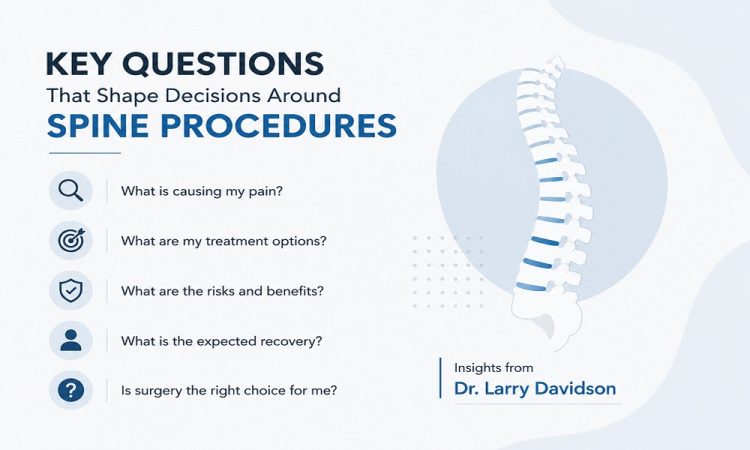
Key Questions That Shape Decisions Around Spine Procedures: Insights from Dr. Larry Davidson

Choosing whether to move forward with a spine procedure often involves more than understanding a diagnosis. Patients are frequently presented with multiple considerations, including the nature of the condition, available treatment options and how each path may affect their daily life. These decisions are rarely straightforward, especially when symptoms have been present for some time or have changed gradually. Dr. Larry Davidson, a board-certified neurosurgeon with fellowship training in complex spinal surgery, often finds that the most productive conversations begin when patients are prepared to ask specific, meaningful questions about their care.
Approaching this process with curiosity rather than urgency can help shift the focus toward understanding rather than simply deciding. The right questions can clarify not only what is recommended but also why that recommendation is being made.
What Exactly Is Causing the Symptoms
One of the most important questions centers on identifying the source of symptoms. Patients may hear terms like disc degeneration, herniation or spinal stenosis, but understanding how these findings relate to their specific experience is essential.
Asking how imaging findings connect to pain, numbness, or weakness can help clarify whether the identified issue is truly responsible for the symptoms. This connection forms the basis for determining whether a procedure is appropriate. Without this clarity, it becomes difficult to evaluate whether a proposed treatment is addressing the right problem.
What Are the Non-Surgical Options
Before considering a procedure, it is important to understand what alternatives may be available. Physical therapy, medications, injections and lifestyle adjustments are often part of the initial approach to spine care.
These options help establish whether conservative treatments have been fully explored and what outcomes can reasonably be expected from them. It also provides a clearer sense of how symptoms may respond over time without surgical intervention. It allows patients to view a procedure as one option within a broader plan rather than the only path forward.
What the Procedure Is Intended to Achieve
Understanding the goal of a procedure is a key part of decision-making. Some procedures aim to relieve nerve compression, while others focus on stabilizing the spine or correcting structural changes. Knowing this distinction helps patients better understand why a specific approach is recommended.
Asking what specific outcome the procedure is designed to address helps align expectations with reality. It also clarifies whether the goal is to reduce pain, improve function or prevent further progression of a condition. This level of detail supports a more informed perspective on what the procedure can realistically accomplish.
How Success Is Defined
The complete elimination of symptoms does not always measure success in spine care. For many patients, improvement may involve increased mobility, reduced frequency of pain episodes, or the ability to return to certain activities.
Discussing how success is defined helps set realistic expectations. It also provides a framework for evaluating outcomes after treatment. Dr. Larry Davidson has pointed out, “We need to set realistic expectations and redefine what success looks like. It may not mean being completely pain-free like they were as a young adult, but it could mean meaningful improvement in function and quality of life.” This perspective helps patients approach decisions with a clearer understanding of what progress may look like.
What the Risks and Trade-Offs May Be
Every procedure carries potential risks as well as benefits. Asking about possible complications, recovery challenges, and long-term considerations provides a more balanced view of the decision. This broader perspective helps patients weigh outcomes in a way that reflects both immediate and longer-term implications.
Understanding these trade-offs allows patients to weigh whether the potential benefits align with their priorities. It also helps avoid focusing solely on the expected outcome without considering the full scope of the procedure. This transparency supports more thoughtful and individualized decision-making.
What Recovery May Involve
Recovery is often one of the most important considerations for patients. Asking about expected timelines, activity restrictions, and rehabilitation requirements helps clarify what the process may look like. This understanding can make it easier to plan daily responsibilities during that period.
Understanding how recovery fits into daily life, including work and personal responsibilities, allows patients to plan more effectively. It also provides insight into how long it may take to return to normal activities. This preparation can reduce uncertainty and support a smoother transition through the recovery phase.
Whether the Timing Is Appropriate
Timing can influence both the decision to proceed and the outcome of treatment. Some conditions may improve with continued conservative care, while others may require more timely intervention. Understanding where a condition falls along that spectrum can help guide more informed decisions.
Asking whether waiting is an option or whether earlier treatment may be beneficial helps clarify the urgency of the situation. This question also provides insight into how the condition may progress over time. Understanding timing allows patients to approach the decision with a more complete perspective.
How the Decision Fits into Long-Term Care
A spine procedure is often one step within a larger care plan. Asking how the procedure fits into long-term management helps connect immediate decisions with future health. This broader view helps place the procedure in context rather than seeing it as a standalone solution.
It may include understanding how to maintain spine health after treatment, prevent recurrence, or manage ongoing symptoms. It also highlights the role of rehabilitation and lifestyle adjustments in supporting long-term outcomes. Seeing the procedure in this broader context helps patients make decisions that align with both current and future needs.
A More Thoughtful Approach to Choosing Care
The decision to pursue a spine procedure is rarely based on a single answer. It develops through a series of questions that bring clarity to the diagnosis, the available options, and the expected outcomes. Each of these questions helps build a more complete understanding of what the decision involves.
By approaching consultations with a clear set of questions, patients can engage more actively in the process. That level of engagement often leads to more confident and well-considered choices that are aligned with both clinical findings and personal priorities.